Alpinestars Supertech R7 Helmet

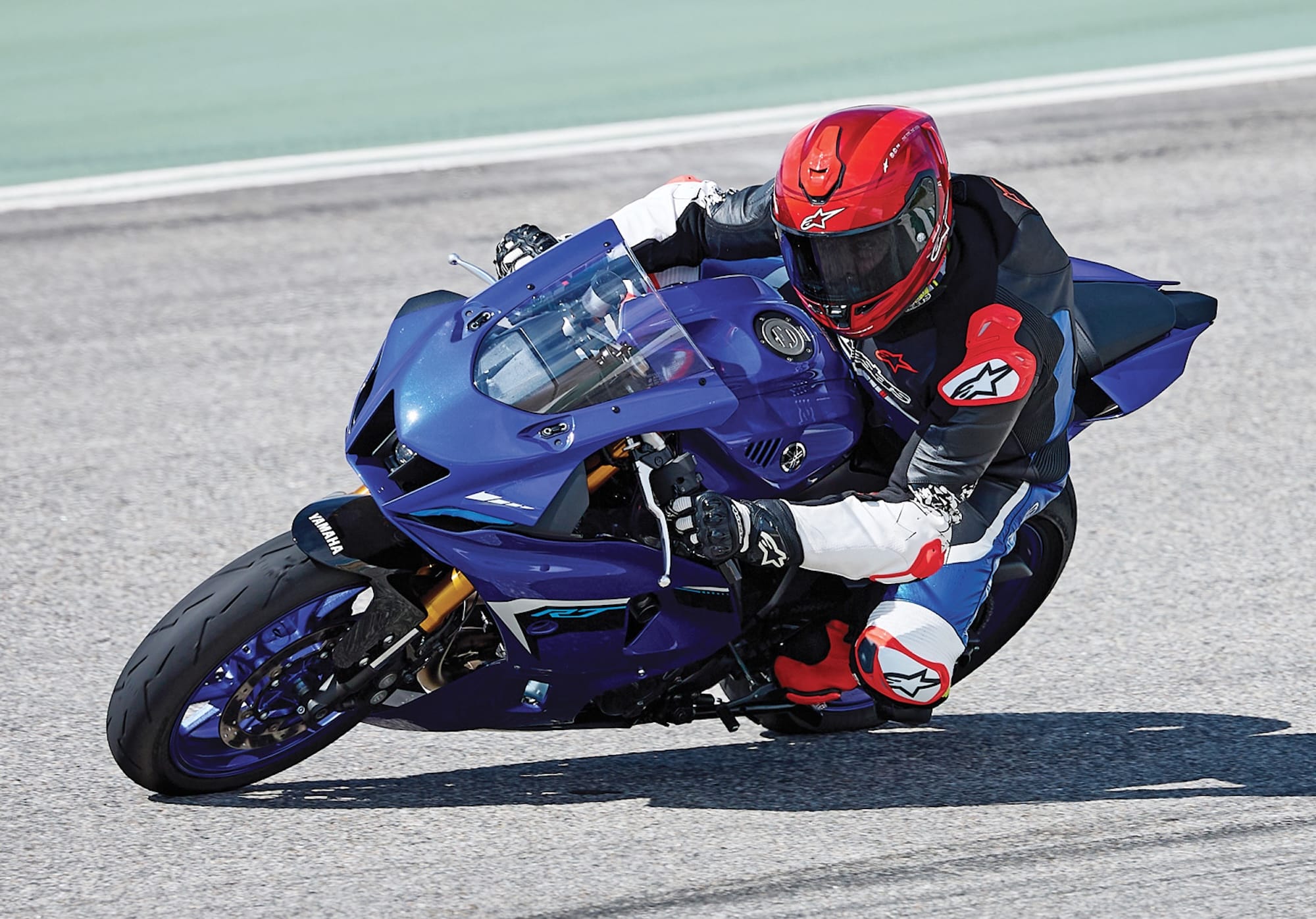
A few years ago, Alpinestars introduced the Supertech R10 (S-R10), its first full-face helmet for road racing motorcyclists. It is a premium piece of head protection, priced above equivalent models from established competitors. For 2026, Alpinestars is bringing to market the Supertech R7 (S-R7), a more affordable roadgoing version of its high-performance counterpart.
Similarities between the two models are abundant, beginning with their interchangeable faceshield. The faceshield features an anti-scratch surface and turbulators on each side of the shield, intended to improve aero-acoustic performance. S-R7 shields come equipped with pins for attaching a Pinlock anti-fog insert (included) and tear-off attachments for the track.
The centrally located shield lock is a unique design. It uses a metal hook that automatically swings down when closing the faceshield, locking it in place. Finding the metal hook with a gloved finger to release it takes some practice, though.
The S-R7 has a large field of view, which can be adjusted via Alpinestars’ unique A-Head system. It allows you to adjust the depth at which the helmet rests on your head and the extent of fore-and-aft pitch. For example, when seated in an aggressive tuck position for track riding, rotating the helmet rearward improves your field of vision, whereas when riding more upright on the road, rotating it forward is better. Adjusting the fitment involves snaps at the four corners of the crown pad, each with three different positions, providing a wide range of adjustability.
Unlike the S-R10, the S-R7 was designed with rider communication in mind. The purpose-built A-Connect system ($549) features a four-key integrated control unit on the left flank and a battery tucked neatly inside the rear of the helmet. Produced by Sena, the system features 40mm Harman-Kardon speakers and other technologies, including AI-based noise cancellation. The automatic On/Off function is a neat feature; it detects when the helmet is not in use, puts the system to sleep to save battery life, and automatically resumes when it detects motion.
The S-R7 comes in three different shells and a seven-piece, multi-density EPS liner. The internal comfort liners are available in various thicknesses. My size Medium fit comfortably, leaning toward racetrack-style snugness. The 25mm stock cheek pads exert vice-like pressure. I ignored it when focused on the track, but on the street, the discomfort grew with each passing mile. Alpinestars offers 15mm and 20mm cheek pads, and I think the 20mm would be perfect for street comfort.
The ventilation system comprises six intake and four exhaust ports. Airflow across the crown of my head was certainly noticeable with the top vent open. The centrally located chin intake port has a removable cover, which I believe would get lost quickly. Whereas the S-R10 utilizes a 3K high-density carbon outer layer, the S-R7’s outer shell is fiberglass. Underneath it are unidirectional carbon composite, carbon aramid fiber, and glass/nylon fiber layers.
The best I can say about the S-R7 is that I never thought about the helmet unless I was purposely thinking about it. The S-R7 was comfortable (but not as comfortable as my Arai Corsair), quiet, and amazingly stable at racetrack speeds. Utilizing the A-Head system and swapping between 20mm and 25mm cheek pads, the S-R7 is, for me, an incredibly competent street/track hybrid helmet.
Alpinestars Supertech R7
From $680 (plain); $749.95 (graphics)
Sizes: XS-2XL
Colors: Black Matte, Black Glossy, Gray Glossy, White Glossy, and graphics