1000 Miles on the Blue Ridge Parkway


The distance between Cherokee, NC, and Waynesville, VA, is 476 miles if you travel along the Blue Ridge Parkway. Make it a round trip ride and your total comes to 952 miles—only 48 shy of a grand.
Most riders take three or four days to complete this ride at a leisurely pace, but Caleb and I aren’t most riders. Having completed our first Saddle Sore 1000 only a few months earlier and knowing that each of these attempts must be more difficult than the last, we knew what we had to do: a Saddle Sore 1000 on the Blue Ridge Parkway.
Straddling a pair of Yamaha Tracer 9 GT+s, we began this long-distance ride in Hot Springs, NC. The town is approximately 50 miles from the Blue Ridge Parkway’s southern terminus, and almost exactly the distance we needed to tack on to make our 1,000-mile dream come true. Our official start time read 10:20 a.m.

Ask any accomplished member of the Iron Butt Association how they typically start off their attempts at a long-distance ride like this, and they’ll likely say “get a strong start.” You should start your ride at a place where you can maintain a higher rate of speed and tackle as much distance as you can while you’re fresh.
We didn’t do that.
Motorcycles & Gear
2024 Yamaha Tracer 9 GT+
Helmet: HJC RPHA 11 Pro
Jacket: Klim Marrakesh
Pant: Klim Outrider, Klim Betty Tapered
Boots: Gaerne Balanced Oiled
Gloves: Klim Dakar
Luggage: SW-Motech Legends Gear Tankbag
Comm System: Cardo Packtalk Edge
Camera: Nikon Z 6II, 24-70mm F2.8, GoPro Hero 12 Black
Naturally, we started our undertaking on one of our favorite twisty mountain roads—SR 209. This 36-mile stretch is so curvy, it’s been nicknamed the Rattler.
Before we could begin our journey along the Blue Ridge Parkway, we had to tackle nearly 300 curves. At least our tires would be warm.

11:00 a.m., Cherokee, NC—Mile 51
Once in Cherokee, we topped up our fuel tanks and grabbed a photo of our receipts and odometer to mark our southernmost point for this ride. What lay ahead was 952 miles of scenic, non-stop highway following ridgelines through southern Appalachia.
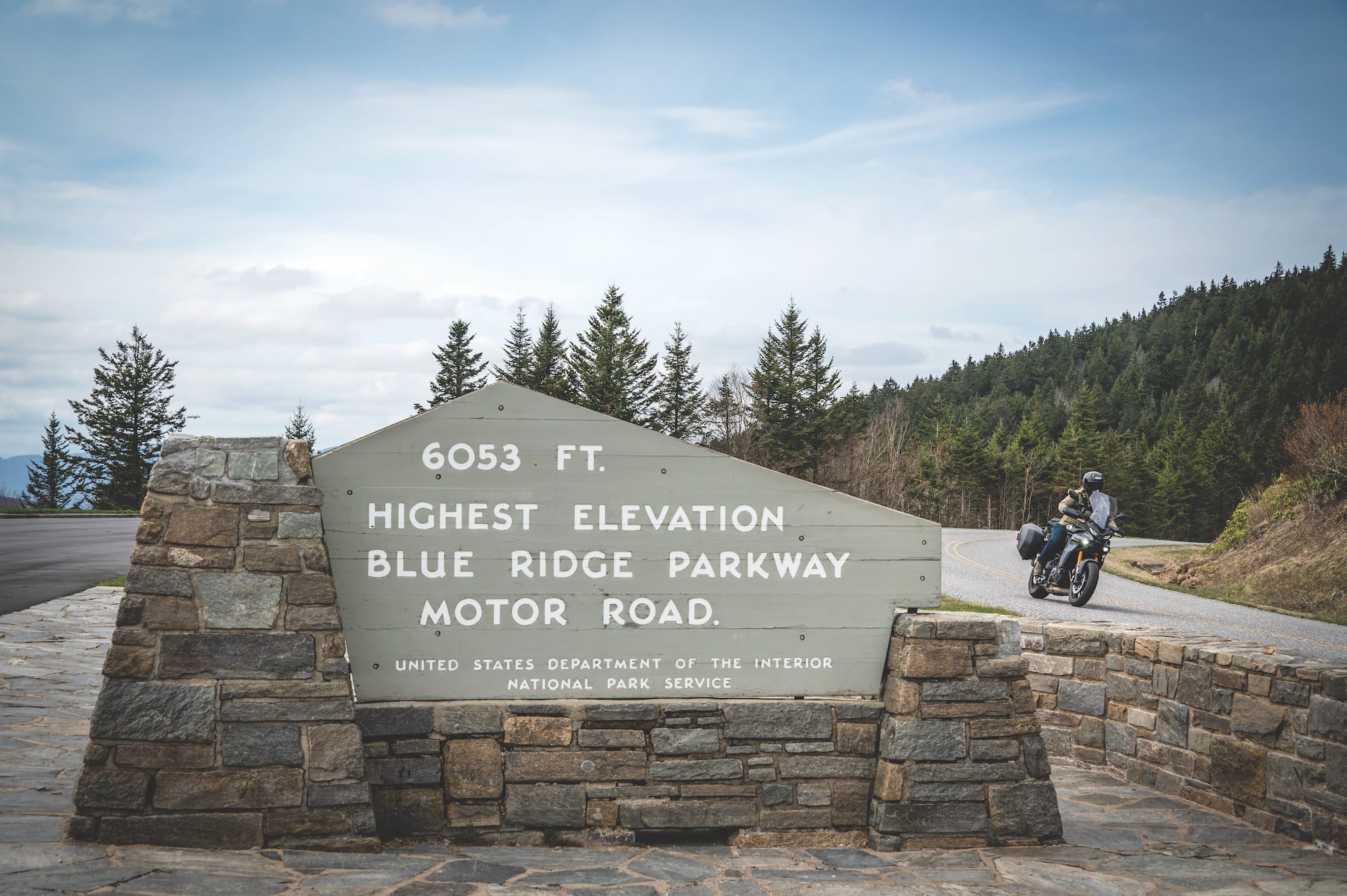
Alas, as we turned onto the Blue Ridge Parkway, our delays began—we had to stop for photos with the sign. Even though we made quick work of it, I estimated that this trend of stopping to document our ride likely added about an hour and a half to our overall time. You’re welcome.
Convenient Solitude
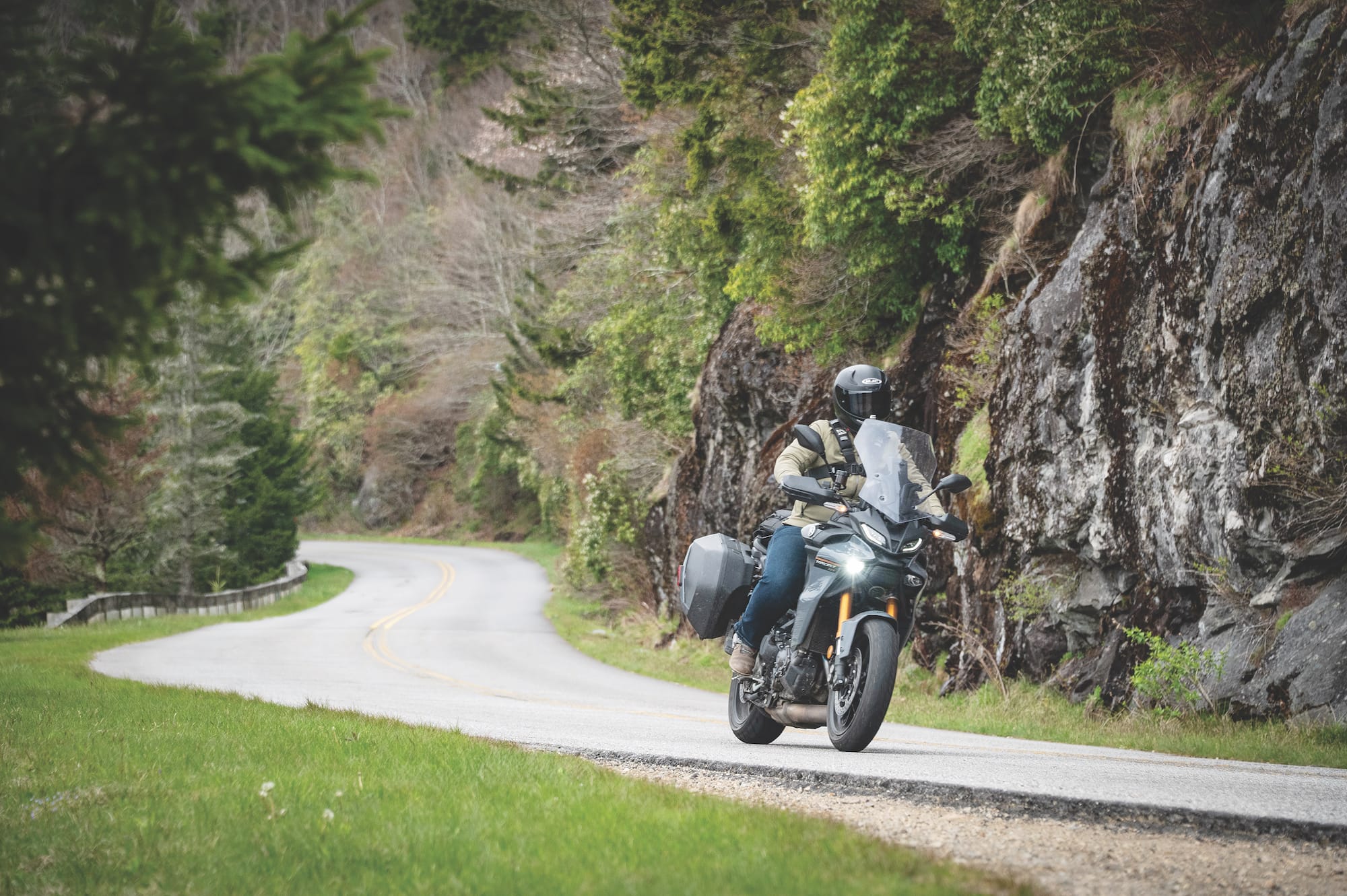
We had the parkway to ourselves for the first 150 miles or so. The bright green of early spring lined the road on each side and, in some areas, moss coated the edges of the pavement.
Potholes were plentiful, likely due to the harsh winter that had just recently broken. We made a mental note of them, knowing they might slow us down come nightfall.
2:56 p.m., Spruce Pine, NC—Mile 198
Our rest stops were carefully calculated, mostly because there aren’t too many gas stations along the Blue Ridge Parkway. We also wanted to make the most of each tank of fuel.
Stop too often or for too long, or venture too far off your planned route, and you risk running out of time at the end. We knew this one would be cutting it close, so we took no chances.
6:28 p.m., Meadows of Dan, VA—Mile 377
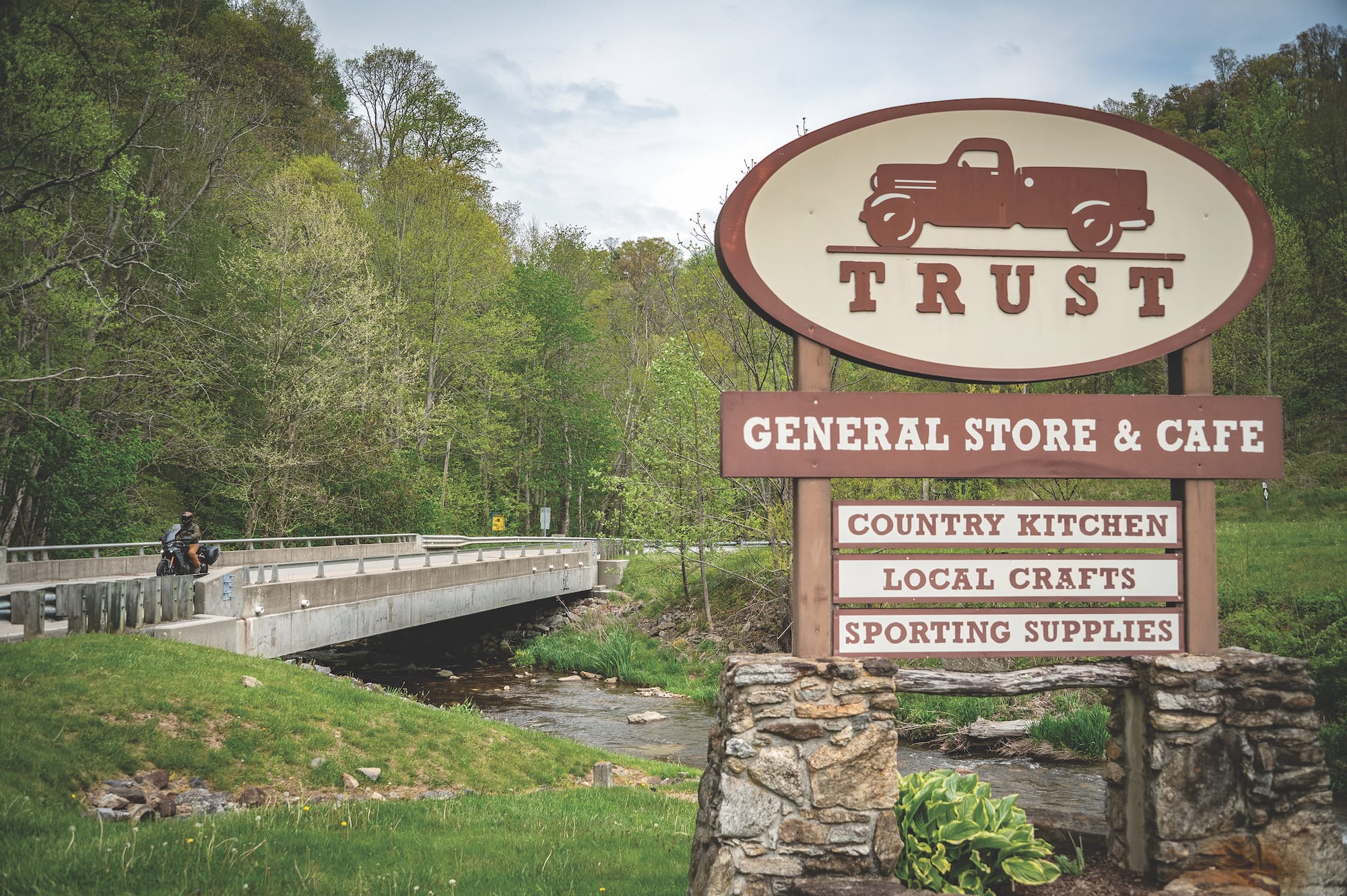
We left the Poor Farmer’s Market in Meadows of Dan, VA, with the sun sinking low on the horizon. I basked in the warmth of the final rays of light, secretly wishing we were about to pull into the driveway of a nice bed-and-breakfast for the night.
I didn’t let Caleb know I was already tired and could use a hot shower, but the thought crossed my mind more than once. Deciding that contaminating his thoughts with my own would only hurt our progress, I kept the daydreams to myself.
In the blue twilight, we continued on, milking every ounce of light we could before falling into darkness. Suddenly, a large fuzzy black object moved along the side of the road. We caught it in our peripheral vision and exclaimed to each other over our intercom, “Bear!”
We slowed, our heads on swivels, as we searched for a better view of the black animal. Darting between the trees, it was gone as quickly as it appeared.
An Inconvenient Detour
Just outside of Roanoke, we ran into a big problem. Roadwork along the Blue Ridge Parkway had just begun, and a large section of the route was closed. Detour signs were posted, but thinking we knew better, we stopped to recalculate.
We tried in a few spots to get back on track, only to find a dead end. Eventually, we settled on following the detour signs, which took us for 80 miles through nearby towns before eventually depositing us back on the parkway.
The mileage was about the same as if we had stayed on course, luckily, but it did cut out a small chunk of the route we intended to take. Worse, we sacrificed too much time attempting to outsmart the road crews and navigate the closure ourselves.
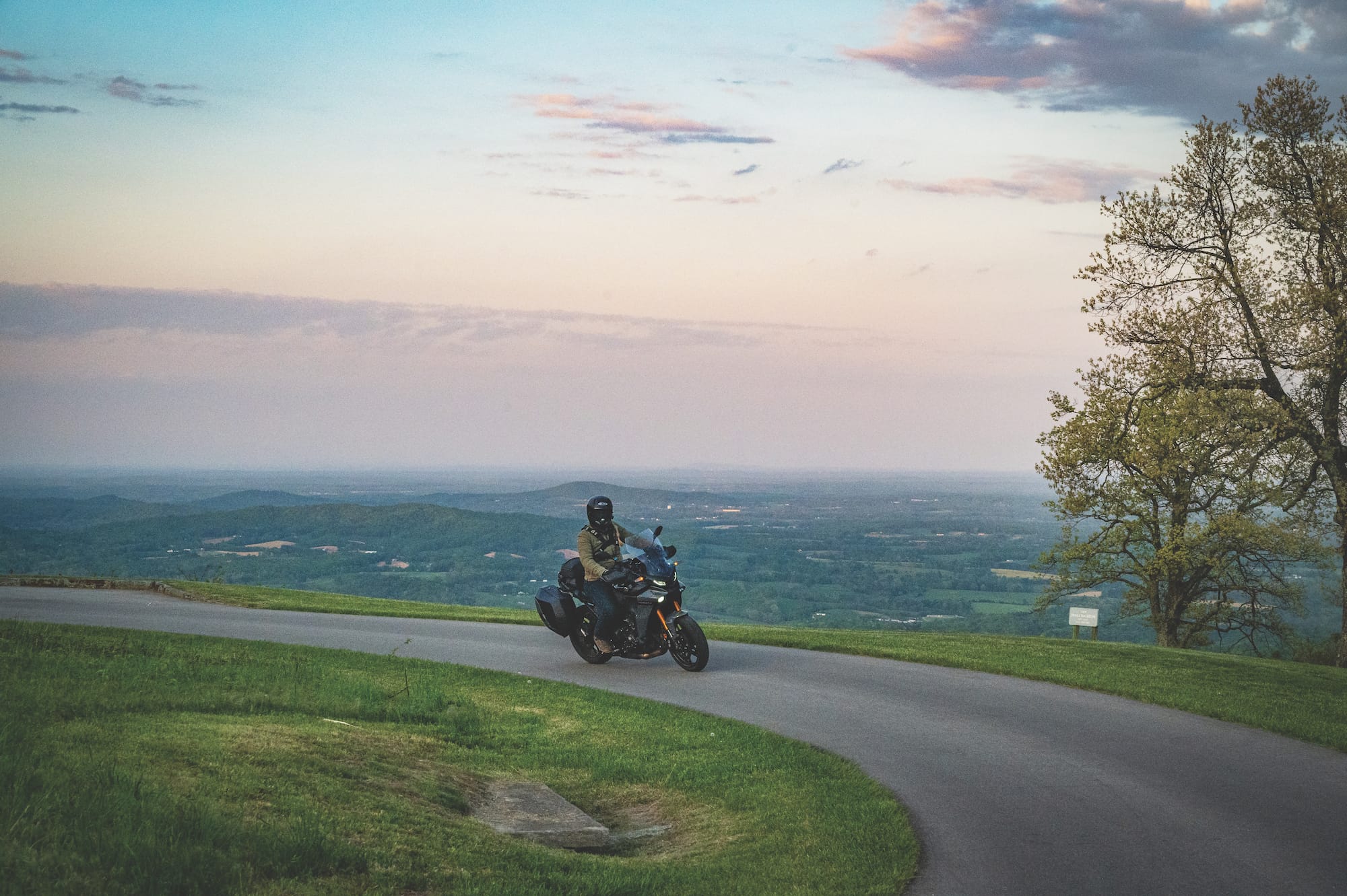
Darkness in the mountains is on another level, and that can be dangerously apparent when you’re riding a motorcycle with stock headlights all night long. When it became too dark for us to see, we made a quick stop to swap from our tinted faceshields for clear ones. Riding at night (on purpose) is not something we tend to do often, but it’s not like we had a choice.
Our pace slowed as the night enveloped us, which I was OK with due to the falling temperature. With every possible insulating layer on, I was able to keep warm if I focused on strategically contracting and relaxing various muscle groups—a trick taught to the Navy SEALs when they are going through BUD/S training. Thanks for that one, Discovery Channel.
But even with Navy SEAL tricks, the final stretch toward the northern terminus turned what was already a challenge into a much more difficult one.
Oh Deer, the Fog
As we followed the ridgelines, dense clouds began to rise up and cover the road in front of us. Our already slower-than-desired pace became even slower.
We knew if this kept up too long, our chances of finishing would be slim. The high beams became useless in the thick fog, forcing us to change to low beams. We were quite literally riding blind, but we had to press on if we wanted to make it on time.
Then, as if we needed anything else to worry about, deer began to appear along the side of the road. At first, it was just one or two—then, herds of them. They were running, jumping, and generally being unpredictable, as deer predictably are.
Between the darkness, fog, deer, and underpowered headlights, it was a recipe for potential disaster. At a crawling pace, we inched our way north, hoping for a gas station with hot coffee in Waynesboro.
12:12 a.m., Waynesboro, VA—Mile 569
Our focus at this point had shifted to staying warm while maintaining as much speed as possible given our diminished visibility and the threat of wildlife. We were just over halfway through, and the thought of doing this all again, only in the opposite direction, was daunting.
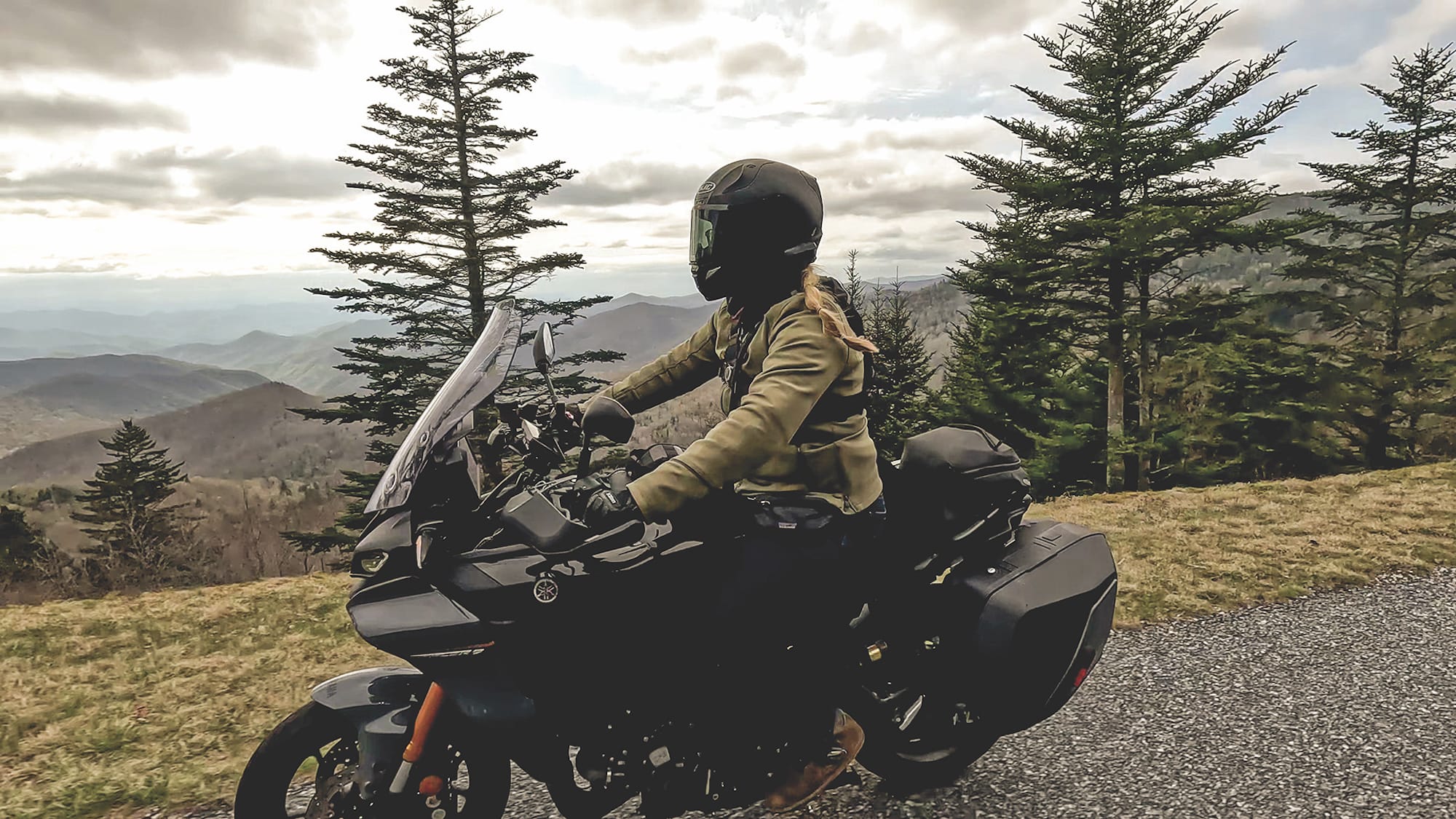
We decided to take a slightly different route when it came time to detour around the closed road again—with several hours of forethought this time. Turning west, we rode through the valley that offered both a slightly higher speed limit and temperature.
3:03 a.m., Max Meadows, VA—Mile 724
Caleb and I continued south until we reached Max Meadows, then turned east and climbed back onto the Blue Ridge Parkway. We had 250 miles to go, and although it was slightly warmer and the fog had lifted, the ride had not gotten any easier.
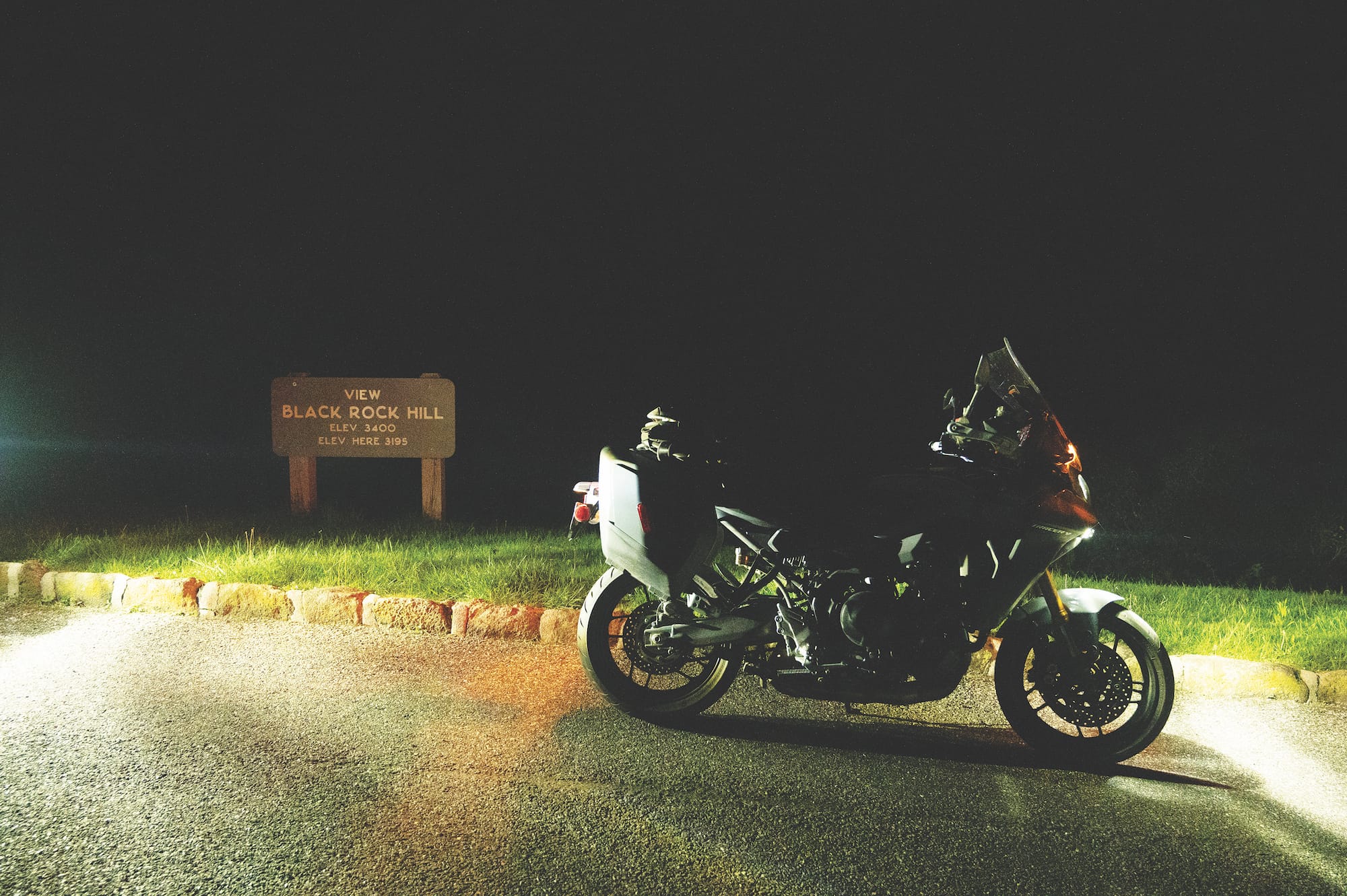
It’s All In The Head
For me, the most mentally taxing part of any endurance ride are the hours between 3:00-6:00 a.m., which usually coincides with crossing the 750-mile mark. This is the time when it’s been dark for a while, my energy stores are dwindling, I’m sick of being on a motorcycle, and I’m so exhausted that no amount of coffee helps.
When this type of fatigue sets in, it severely affects your mental acuity. Your decision-making skills diminish, reaction times get slower, and your body can start to shut down. It’s in these moments that staying hydrated and maintaining some sort of conversation with your riding partner can save you.
Lucky for me, I wasn’t alone on this ride.
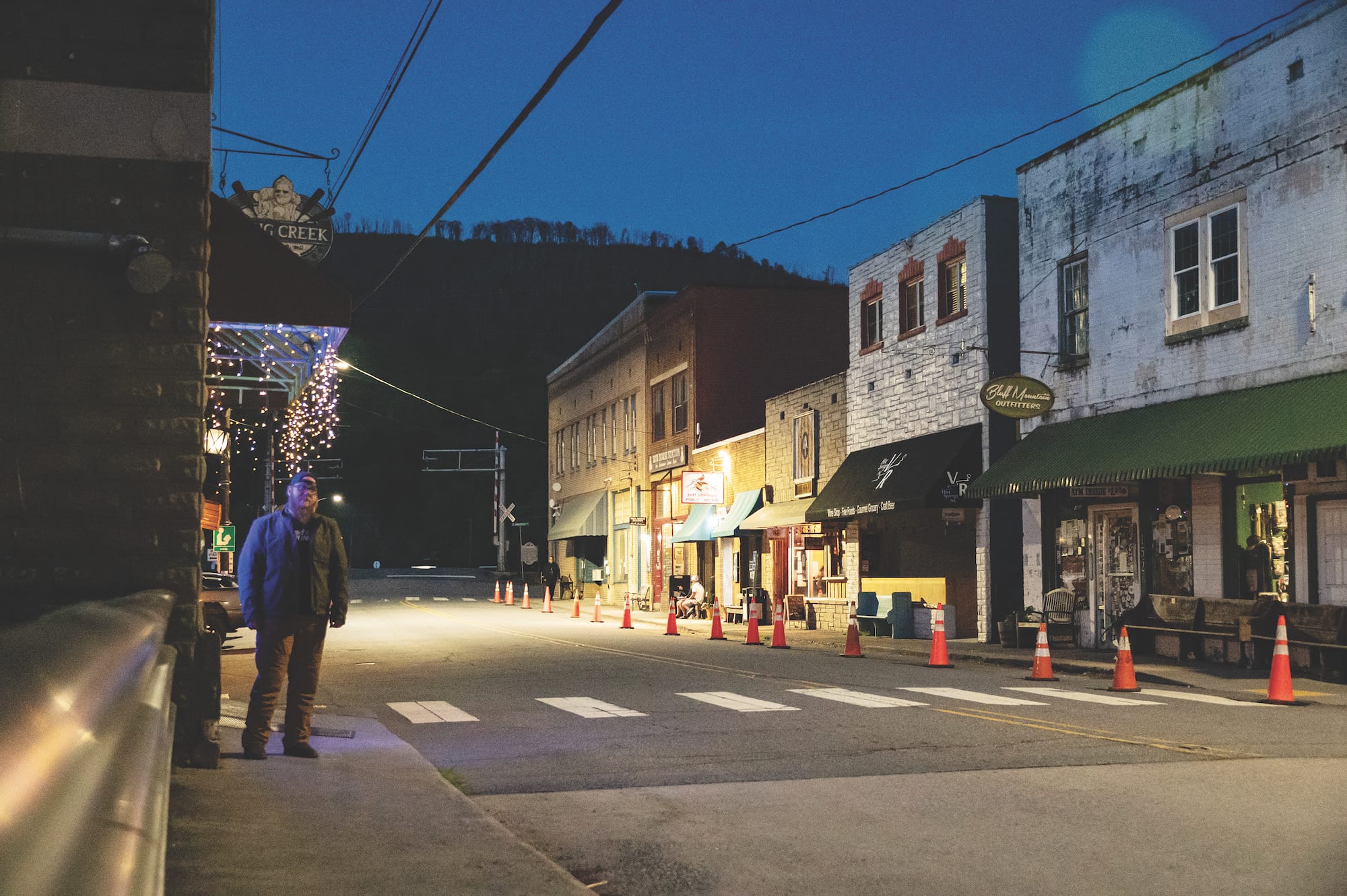
Caleb and I took turns telling each other stories, asking questions, and calling out things along the side of the road. This is a tactic we have developed to help keep us engaged and paying attention during deep states of fatigue in the wee hours. When road hypnosis creeps in, having a conversation can help keep the mind sharp.
6:30 a.m., Spruce Pine, NC—Mile 879
A sense of relief washed over me as the sun began to rise. Somehow, seeing those first rays of light in the sky replenished my spirits and I started feeling better.
At this point, we had less than 200 miles left to ride, which felt like such a small distance. As we would soon find out, though, one unexpected consequence of riding a thousand miles of consecutively twisty roads was unusual tire wear.

Balled Rubber
As I leaned into the corners, I noticed my bike’s handling becoming erratic. “Am I tired or is the bike handling worse than before?” I thought to myself. Eventually, I asked Caleb if he was experiencing the same thing, and he was.
The sides of our tires had worn out before the center strip, so each dip into a corner became increasingly exaggerated. What was once an easy corner to hold a line through was now very difficult. I felt myself making countless corrections throughout each curve, adjusting to maintain correct positioning and speed.
In an effort to distract ourselves, we decided to crunch the numbers. We counted the curves over 10 miles, and then multiplied that by roughly 47. Over the parkway’s 476 miles, we estimated that we had to ride approximately 4,700 curves.
Double that to account for the round trip and you’re left with 9,400 corners of varying degrees.
That’s a lot of action for any tire, so it was no wonder they were feeling a little silly at this point. Never in my riding career have I worn out a pair quite like this. Then again, never in my riding career have I ridden a thousand miles of pure twisties in one sitting.
Between the relentless corners, the abrasive pavement, and the warmth in the rubber from riding this long, of course they were starting to disintegrate.
In the final southern stretch, we stopped at the Funnel Top Overlook. Although it may have been a touch premature, we celebrated our ride with a victorious hoot and holler as we warmed our hands by the ticking exhaust. We stayed only long enough to thaw our fingers before making the final descent into Cherokee.
Just as we pulled into the fuel station in Cherokee, it began to drizzle. We fueled up and snapped the obligatory receipt and odometer photo before going inside for a warm cup of coffee.
This had been a much more challenging Saddle Sore experience than our first, and we were grateful to have finished just in the knick of time. At 9:54 a.m., we were done with 26 minutes to spare.
Inconvenient Iron Butt Series
Any Iron Butt ride is challenging due to the relentless demand for long-distance endurance. The Saddle Sore 1000 pushes riders to navigate over 1,000 miles within a tight 24-hour timeframe.
The physical strain, mental resilience, and the need for meticulous planning in the face of unpredictable variables make it an arduous test of both rider and machine. To accomplish any Iron Butt ride is a victory in and of itself, even on the most comfortable long-distance touring bike. Start manipulating certain factors and it quickly becomes even more daunting.
Caleb and I have set out to complete a series of Iron Butt rides, each with an increasing level of difficulty and a unique challenge. Our first attempt in this series gave us a small taste for what goes into completing a ride of this magnitude as we hunted for whales in the Nevada desert.
To add complexity to our second attempt, we opted for a road with lower designated speed limits and fewer gas stations—the Blue Ridge Parkway. On top of that, this route is known for tourist traffic, and the risk of getting jammed up at an even slower pace was very real. Add in some things you can’t expect, like weather and wildlife, and we were facing a difficult challenge.
Additionally, we had to stop periodically to take notes and photos of the experience—we’re doing this for the story, after all. Think of it like doing four or more consecutive Shamrock Tour® loops, completing them all within 24 hours, and documenting everything along the way.
Our Iron Butt challenges will become increasingly more difficult as we progress through the series. The next Inconvenient Iron Butt is coming soon.
Facts & Info
Approximately 1,000 miles
Overview
Riding a thousand miles along one of the most beautiful roads in the eastern U.S. was not something anyone had to twist our arms to do.
This is one of our favorite roads for a reason, and any chance to put miles down on the Blue Ridge Parkway is a welcome one. This 24-hour journey tested us in many ways—some of which we were expecting, and some we weren’t.
As is possible on any ride along the Blue Ridge Parkway, we experienced a variety of weather conditions and wildlife, which added an extra twist of excitement to the ride.
Roads & Riding
The Blue Ridge Parkway is managed by the National Park Service. The road surface is generally in good repair, but be cautious of potholes when traveling in the early spring. The sides of the road can also become mossy, so be cautious of that as well.
The speed limit ranges from 30 mph to 45 mph, and there are often cyclists on the road. In the busy months, there can be quite a bit of traffic, and there are lots of pull-offs with beautiful views along the way.
Elevation reaches over 6,000 feet, so be sure to pack warm layers if riding in the swing seasons. Gas stations are few and far between, so plan accordingly.