Text: John M. Flores • Photography: Tom Riles, Brian Nelson, John M. Flores
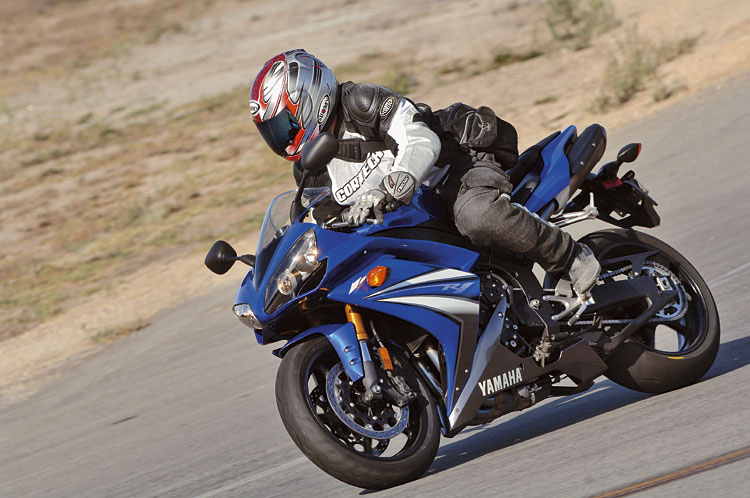
Place the tip of your thumb and forefinger three millimeters apart. That's about 1/10 of an inch, and how much Yamaha engineers raised the rear swingarm pivot on the 2007 YZF-R1. Chew on that for a second - not 2mm, not 4mm, but 3mm, to reduce chain tension under power. That's just one instance of the continuous refinement characterizing the 2007 R1, the successor to the iconic bloodline that first burst onto the scene in 1998.
It's hard being an icon. Just ask Ducati, who misfired with their 999, or Honda, whose CBR900RR dropped jaws in 1993 but stumbled into middle-age just five years later. Yamaha has worked hard to avoid a similar fate. As well they should - the R1, making up 26 percent of the 1000cc sportsbike market, has tallied 25 percent sales growth from 2001-2002 to 2005-2006. With the overall market for sportsbikes booming 59 percent in that time frame, it's important for Yamaha to stay on its game.
They haven't messed with the basic R1 formula - one state of the art 1,000cc, inline-4 motor suspended from a modern, lightweight chassis, wrapped in sharp, aggressive bodywork - however, they have made many small changes that add up to a new and improved motorcycle.
Drivetrain
The R1 motor features the same 77mm x 53.6mm bore and stroke as the prior model, but Yamaha has moved away from the signature 5-valve head, a longstanding feature of their top-end sportbikes. Engineers claim that the 4-valve head (with titanium intake valves and steel exhaust valves) improves combustion efficiency and power throughout the rev range.
Air is fed to the engine through computer-controlled air intakes. Yes, computer-controlled air intakes, the Yamaha Chip Control Intake, (or YCC-I for readers who speak in acronyms). Each intake is comprised of two tubes stacked directly on top of each other like straws touching end to end. Together, they form a 140mm-long intake tract. At 10,400 rpm and throttle valve positions greater than 57.5 degrees, the top tube of the intake separates from the bottom tube by 28mm via an electric motor, reducing the effective intake length to 65mm. Conceptually, the idea is related to Honda's VTEC system, in that it emphasizes intake velocity at low to mid rpm and intake volume at high rpm. The end result is a wide flat torque curve.
And Yamaha continues to lead the charge towards fly-by-wire throttles, first with the 2006 R6, and now with the R1. The system, Yamaha Chip Control Throttle (YCC-T), measures throttle grip position, throttle valve position, and other parameters 1,000 times a second. The throttle is closed the old-fashioned way, with a cable, to prevent speed-hungry electronic gremlins from jamming the throttle wide open.
(End of preview text.)
For the complete article of the riding impression(s) and technical specifications, please purchase the September/October 2007 back issue.