Special Victims Unit

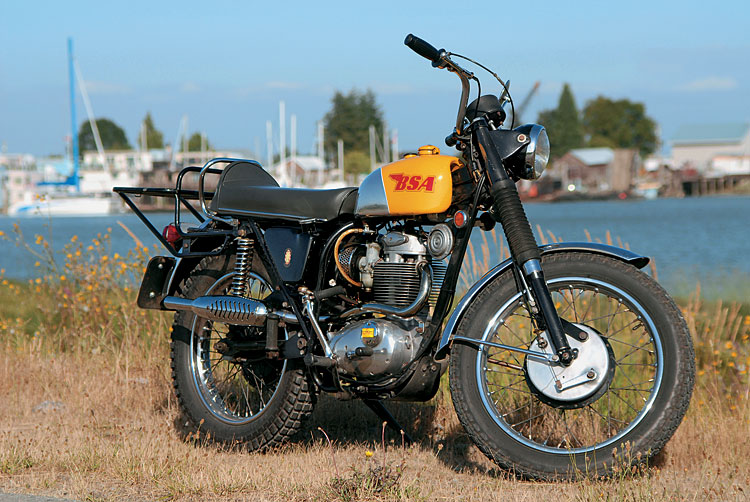
I can still remember opening my copy of Motor Cycle News and seeing BSA's announcement of their motorcycle range for 1966. I was fifteen, motorcycle crazy and a big fan of motocross, which was then called 'scrambles.' Jeff Smith had just won his second successive world championship on the 440cc BSA Victor, and to cash in on its investment, BSA introduced a road-going version of the Victor for 1966. It was chunky, aggressive and had a shiny, yellow-painted alloy gas tank. I wanted one so badly I could scream.
It was another ten years before I owned one. By the time I turned 16 and got my bike license, the girls I was interested in preferred scooters to motorcycles, so that's what I rode. And then the advantages of four wheels for cherchez la femme became apparent, so I traded my Vespa for a 1955 flathead Ford. But my lusting for a BSA Victor never completely went away.
It wasn't long before I was back into bikes, and after a couple of years commuting on a Honda 125, I decided it was time to move up, and found a used 1969 BSA Victor. Actually riding the BSA after my little Honda was a major disappointment. Where the Honda was slick, sophisticated and easy to ride, the Beezer was stark, clunky and ornery. I pretty much only had to look at the Honda and it would start, while I sweated away trying to kick the BSA into life. The Honda ran like a Swiss watch; the BSA shuddered and misfired. Its favorite trick was stalling at traffic signals just as the light turned green. Trying to kick it back into life from the saddle often resulted in little more than an angry contusion on the back of my thigh from the thoughtlessly located oil filler tube.
I couldn't find parts for it, nor anyone who could help with knowledge or insight. And while Gold Stars and Vincents were becoming collectible, later British bikes, especially the BSA unit-construction singles, were just so much junk. The world had moved on, and the obsolete Victor was caught in the twilight zone between trash and treasure. I had become, I found out, a 'victim.'
The Victor Story
All BSA unit-construction (the gearbox in unit with the engine: earlier British bikes mainly had separate gearboxes) singles trace their lineage back to the Edward Turner-designed 150cc Triumph Terrier of 1953, a simple, unsophisticated four-stroke single intended as a cheap commuter. This soon grew into the popular best-selling 200cc Tiger Cub. The BSA group had owned Triumph since 1951, and for 1958, BSA announced the C15, a new 250cc four-stroke single based on the Cub with cylinder dimensions of 67mm x 70mm. This proved to be a solid, reliable little bike, and tens of thousands of British teens cut their motorcycling teeth on one. It was cheap, cheerful, and tunable too. Before long the C15S scrambler was winning trophies in motocross, especially when piloted by BSA team rider Jeff Smith.
BSA next produced a 350cc version of the single, the B40, by increasing the bore from 67mm to 79mm. This also sold well and became the British army's standard motorcycle until replaced in the seventies. A sports version for 1962, the SS90, soon developed a reputation for fragility, perhaps indicating that the limits of the basic 150cc design were being approached.
Meanwhile, in BSA's competition shop, an even larger capacity version was being developed in the hope of gaining the 500cc world motocross championship. By repositioning the crankpin in the flywheels, experimental engines of 420cc and finally 441cc, matching a 90mm stroke to the B40's 79mm bore, were produced. It was a modified C15S framed bike with the 441cc engine that Jeff Smith rode in 1964 and 1965, taking the 500cc world motocross championship both years. The bike was christened 'Victor.'

BSA poured plenty of money into the Victor program in 1966 in hopes of taking a third championship against the challenge of the new lightweight two-strokes. An experimental titanium frame reduced weight but it was prone to cracking and couldn't be repaired in the field, while little more power was reliably available from the engine. Paul Friedrichs took the title on a two-stroke CZ. New rider John Banks took up the challenge for BSA in 1968 and '69 with a full 500cc machine, finishing second in the championship both years. But it was the end of the line for four-stroke machines in motocross, until the recent rule changes. Nevertheless, two 500cc world championships had been won with an engine that started life as a 150cc 'tiddler.'
Life with Victor
Though the Victor became popular as an off-road bike in the late sixties, it had a number of fundamental flaws that plagued it over the years, and its owners were jokingly referred to as 'Victims.' First, the early street-legal models were little more than motocrossers with lights. They retained the 11:1 compression of the race bikes and were fitted with Lucas's temperamental 'Energy Transfer' battery-less ignition system. Trying to kick-start a high-compression big four-stroke single with intermittent sparks was a challenge.
Second, the engine inherited its bottom end from the 350, meaning the big end bearing was somewhat undersized for the job, leading to early bearing failure while the light flywheels meant power delivery was rough at low revs. All of this was OK for a dirt bike, less so for the street. The transmission, also from the 350, suffered from the extra power, too - bearings had a short life, clutch slip was always a problem, and the engine's torque would sometimes bend the gearbox mainshaft.
By 1969, the Victor had become more street-oriented, with lower 9.5:1 compression, battery/coil ignition, and even a heat shield for the waist-level exhaust. For the purists it had sold out, but for the rest of us, it was a much better machine to live with.
To make my 1969 Victor even more street savvy, I've fitted modern electronic ignition so it starts more easily, an oil filter to ensure clean oil for the big end bearing, and a larger countershaft sprocket to reduce engine revs at road speeds. A re-sleeved carburetor also means smoother running.
Sadly, BSA finally got the big single street bike formula right, but only when it was too late for the company. The 1971 Victor 500 had a full 499cc engine of 84 x 90mm with a larger big-end crankpin, three main bearings and strengthened drivetrain. The B50 engine was powerful, reliable and more user friendly. Remarkably, it was still being used as the basis for the British-made CCM motocross machines until the early 1980s. BSA went bust in 1973.
The Knack
There's a trick to starting a B44 that makes it so easy, I'm sure I could start it by hand. The carburetor has to be 'tickled' and the engine turned over so that (using the decompressor) the piston is just past top dead center on the firing stroke (easier than it sounds). Then with a firm, committed swing at the kickstarter with the throttle closed, a well-maintained B44 will almost always start the first time. If I knew then, etc.
With modern ignition and the rebuilt carb, my Victor now starts easily and runs smoothly. It's light and nimble in traffic, accelerates quickly (up to about 40mph, anyway), and the torque (and rearward weight bias) will easily hoist the front wheel. With gas prices rising and this bike returning better than 60mpg, its time may be yet to come.
Who says I'm still a Victim?
Technical Specs
1969 BSA Victor 441
Owner Robert Smith, Ladner, British Columbia
Engine 441cc overhead valve,four-stroke single
Bore & Stroke 79mm x 90mm
Compression 9.5:1
Output 28hp
Lubrication dry sump, gear pump
Carburetor Amal Monobloctype 930, 30mm
Ignition Boyer-Bransden Electronic
Transmission chain primary, wet clutch, BSA four-speed gearbox
Final Drive chain
Front Suspension BSA forks
Rear Suspension pivoted fork with twin shocks
Lighting alternator, 12 volt
Frame welded steel tube cradle
Wheels Dunlop steel rims, BSA hubs.WM3 x 18in rear,WM2 x 19in front
Tires Dunlop K70,4.00in x 18in rear,3.25in x 19in front
Front Brake BSA single leading shoe, 7in
Rear Brake BSA single leading shoe, 7in


