Honda Super Hawk

Although the Super Hawk hasn't enjoyed a lot of sales success overseas, the bike has sold in big numbers in the United States - primarily because its performance characteristics are perfectly matched to US highways and canyon roads, and the needs of many American customers.
Concept & Transformation
The range of liquid-cooled V-twins embodies an illustrious group in Honda heritage. While recognizing their long-lasting career in different cruiser models, Big Red waited until the end of the eighties to step up with a street model using this kind of engine. The Honda NT650GT Hawk was actually the first sport bike powered by this kind of engine, a model with three-valve cylinder heads. But it didn't sell well in the US at a time when Americans used to go for bigger displacements.
It took until 1997 for Honda to release a new model, the Super Hawk (in Europe VTR1000F Fire Storm), displacing 996cc and challenging the traditional V-twins from Ducati and the new Suzuki TL1000S. Compared with these competitors, the Super Hawk struck just the right balance of performance, driveability, and reliability. Moreover, it was a lot less expensive than the divas from Italy. So, altogether, this Honda became a sportbike for the real world, and you could use it for touring too.

Engine & Transmission
The grunt of the engine has remained the same since its introduction in 1997. You press the start button and get immediate response from the big V-twin. The sound of the huge 48mm carbs inhaling and the deep tone from the two mufflers can mesmerize. Engaging the clutch is an easy game and requires much less effort than the Italian V-twins demand. The same goes for changing gears and pulling the throttle. Everything works just fine.
And the big carburetors don't cause any trouble either; usually these sizes are difficult to tune for the transition between "off the throttle" and load. Just so you'll know, no one else has ever tried to deal with these sizes on a stock bike before, a job that Honda handled superbly. The throttle response out of tight or fast turns is perfect, which certainly makes the bike easy to work with for the average rider.
Nevertheless, you can feel the difference in horsepower in comparison to current V2-sportbike competitors from Aprilia, Ducati, and Suzuki. An Aprilia Falco or a Suzuki SV1000 accelerates better and passing is easier. Riders will have to push the Super Hawk harder to get by. However, the Honda performs well when it's all about the right amount of torque in tight turns and in alternating curves. You can trust the engine (even if you didn't hit the right gear) to pull you securely through a winding band of asphalt. For proof of that, there isn't any better road than Deal's Gap, the route we rode putting the bike through its paces during the Honda Hoot in 2003. The Super Hawk meshes perfectly in this kind of motorcycle riding and the "motorcycle world's" other dimensions, including a sedate cross-country tour. Then of course there's a top speed of 151mph, which is more than enough for any sane man's purposes.
Chassis & Brakes
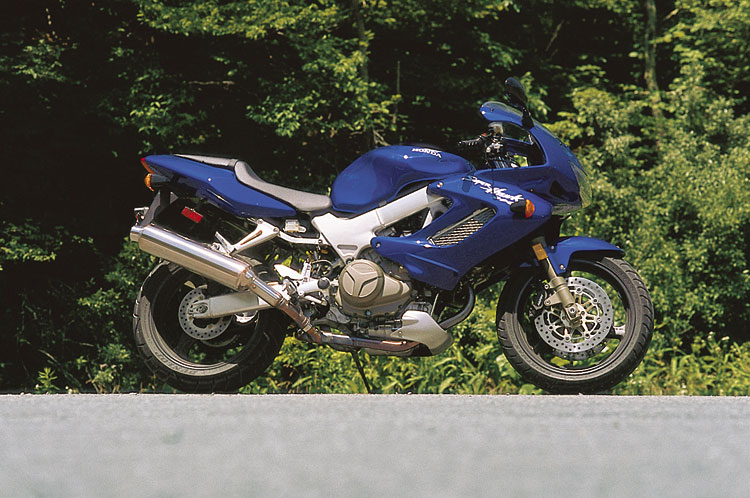
Light feeling, nimble, easily and precisely steered through twisties and stretched highways, the Super Hawk chassis complements its well-balanced engine performance. The narrow fuel tank and the relaxed riding position places you in the sweet spot, right where you want to be to enjoy a long ridin' day.
With sensitivity, the suspension responds to smaller bumps in the road and calmly absorbs the big holes as well. Only on slippery surfaces can one feel a slight tendency for kickback at acceleration. But this isn't threatening at all because it's gone within tenths of a second. So, in order to guarantee easy handling, Honda made the right choice not to go for a steering damper.
Although the Super Hawk doesn't feature any devices like brake support, combining, or antilock system, the brakes are up to date. A small effort to get needed braking power is all that's required. Exerting two fingers is enough to get the double rotors in front to work properly; and in modulation at the edge of riding, leaning over, the braking couldn't be any better. The rear brake takes a little bit more input but this keeps the rear end from locking up too early.

Accessories & Arrangements
A lot of riders might be concerned about the clip-ons of the Super Hawk, but the divided handlebars are mounted moderately low to allow a slightly forward orientation while still producing a comfortable riding position. And there's still enough room between your upper body and the top of the gas tank for a touring tank bag with magnets. A bag strapped down to the rear seat or some soft cases will do for the rest of your stuff on touring trips.
The foot pegs don't ask for tightly folded legs, and the seat manages a nice compromise between comfort and feel for the bike. Also, the seat height of 810mm (31.9in.) fits a wide range of riders. A three-quarter fairing with windshield protects the upper body, providing good coverage from wind and nasty weather. You don't have to tuck in too tightly, as on real sportbikes with those low upper fairings where adding a higher windscreen is a given to get the protection you need on longer trips.
Unlike the Europe version, the American Honda didn't go through bigger fuel tank transition during the years of model refinements. Therefore, the bike kept the performance it was born with - the bigger European gas tank imposed a smaller air box, which bled some torque and horsepower. The downside on the American model is the requirement for making earlier refueling stops - approximately every 160 to 170 miles if ridden moderately. With an average fuel consumption of 46.6mpg, you are almost able to hit 200 miles on the odometer.
Test Summary
We haven't ridden too many bikes during our test years that were this much fun. The Honda Super Hawk is a bike that matches American roads and sportbike customers quite well. Performance is good enough to really irritate other sport touring and sport riders who slapped down much more money for their bikes. We can see why the Super Hawk was so successful in its early years. It's already turned into an American legend in our book.
Technical Specs
Retail Price $ 8,999
Warranty One year, unlimited mileage
Maintenance Schedule 600/4,000/every 4,000 miles (1,000/6,400/every 6,400km)
Importer/Distributor American Honda Motor Co.
Engine
Type 2-cylinder, V, 4-stroke
Cooling water-cooled
Valve Arrangement 4 valves per cyl., DOHC, cams chain driven, shim under bucket adjustment
Bore & Stroke 98 x 66mm
Displacement 996cc
Compression Ratio 9.4:1
Carburetion 2 carburetors, ø 48mm
Exhaust Emission Control no (Europe: catalytic converter)
Transmission
Gearbox 6-speed
Clutch multi-plate wet clutch, hydraulically operated
Final Drive chain drive
Chassis
Frame cast aluminum-alloy frame, double beam
Wheelbase 1,430mm (56.3in.)
Rake 65 degree
Trail 97mm (3.8in.)
Front Suspension telescopic fork
Stanchion Diameter 41mm (1.61in.)
Adjustments spring preload and rebound damping
Travel 109mm (4.29in.)
Rear Suspension aluminum-alloyswingarm w/single shock
Adjustments spring preload and rebound damping
Travel 124mm (4.88in.)
Wheels & Tires
Type cast aluminum-alloy wheels
Front 3.50 x 17
Rear 5.50 x 17
Front Tire 120/70 ZR 17
Rear Tire 180/55 ZR 17
Brakes
Front Brake 2 discs, 4-piston calipers
Diameter 296mm (11.7in.)
Rear Brake 1 disc, floating 1-piston caliper
Diameter 220mm (8.7in.)
Combining no
Dimensions & Capacities
Seat Height 810mm (31.9in.)
Wet-Weight 220kg (489lb.)
Fuel Capacity 16l (4.2gal.)
Performance
Claimed Horsepower (measured at crank)98hp at 8,500rpm
Torque 9.2mkp (90Nm, 68ft.-lbs.) at 6,500rpm
Top Speed241km/h (151mph)
Acceleration 0-100km/h (0-62.5mph): 3.3s
Fuel Consumption 5.1l/100km (46.6mpg)
Fuel Range 314km (196mls.)
Equipment
Three-quarter fairing, dashboard w/speedometer, tachometer, and display for odometer, trip-odometer, cooling fluid temperature, and fuel level, key switch on top of the upper triple clamp, rear seat cover, side stand.
RoadRUNNER Test Diagram
Engine 4/5
Chassis 5/5
Brakes 5/5
Comfort 3/5
Luggage w/accessories 3/5
Equipment 4/5
Design 4/5
Bike for the buck 4/5


